May/June Greetings from the Great Lakes!

Throughout April the days grew increasingly longer, automatically shrinking the hours of darkness.  The sunlight also grew more intense, thereby warming the soil, coaxing dormant plants back to life and seeds to sprout.

Photo: Stephanie Ricker

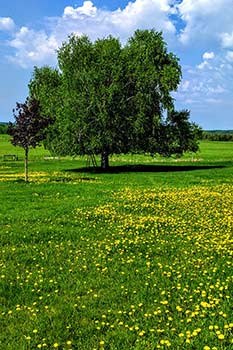
In the month of May the upperGreat Lakesregion witnessed an explosion of green!  Grass seemed to leap up out of the ground.  Bare brown branches were first becoming a lush green canopy.  Dry leaves on the forest floor gave way to green ferns and a myriad of colorful flowers.  Such is the power of sunlight to transform the world.

This month we explore the fascinating subject of “the Bible as light.”

May/June: The Bible as Light

“In the beginning God created the heavens and the earth.  The earth was without form, and void; and darkness was on the face of the deep.  And the Spirit of God was hovering over the face of the waters.  Then God said, “Let there be light”; and there was light.  And God saw the light, that it was good; and God divided the light from the darkness.

Prior to God saying, “Let there be light,” His Spirit was moving over the face of the waters.  Obviously the earth was already in existence.  This is important to note because it resolves a long-simmering debate between Creationists and science—the age of the earth.  God said, “Let there be light” about 6000 years ago.  Yet science can prove the earth is billions of years old.

The answer is simple—billions of years elapsed between verses 1 and 2.  The question remains, why was God’s Spirit hovering over the waters?  An examination of the Hebrew meanings of key words in verse 2 clears up the mystery.

The four key terms to understand are “without form,” “void,” “darkness,” and “hovering.”

  • Without form:  tohuw (#8414, Strong’s, 1995) – to lie waste, a desolation of the surface, a desert, a worthless thing.
  • Void:  bohuw (#922, Strong’s, 1995) – a vacuum or indistinguishable ruin.
  • Darkness:  chosek (#2822, Strong’s, 1995) – misery, destruction, death, ignorance, sorrow, and wickedness.
  • Hovering:  rachaph (#7363, Strong’s, 1995) – to brood.

God was moving over an earth destroyed by evil.  God’s Spirit was brooding over what to do about a planet that had become a desolation, an indistinguishable ruin, a place full of misery, ignorance, sorrow, and wickedness.  This changes the theme of Genesis from that of an absolute beginning from nothing into one of refurbishing, re-creation, and renewal.  We are going to focus on the part that light played and continues to play in God’s plan to refurbish and renew the earth and humanity.

When God said the light was “good,” He was saying it was towb (#2896, Strong’s, 1995) in the Hebrew.  Towb means good, good thing, good man, good woman, to make good, better, or cheerful.  Towb is translated elsewhere in the Bible as beautiful, best, bountiful, cheerful, gracious, and joyful.  Essentially God said, let’s shed light on the world in order to reverse the death, destruction, misery, sorrow, and wickedness, and replace it with good people who live beautiful, bountiful lives full of joy, cheer, and grace.  Thus God re-created man in the form of Adam.  God made man from the elements in common dirt.

“And the Lord God formed man of the dust of the ground, and breathed into his nostrils the breath of life; and man became a human being” (Genesis 2:7).  With Adam God did something unique according to Genesis 1:26-27:  “Then God said, ‘Let Us make man in Our image, according to Our likeness; let them have dominion…So God created man in His own image; in the image of God He created him; male and female He created them.”  Of all living things only man was created in the image and likeness of God.  Man has the ability to think, reason, and be creative like God.  Most remarkably, the mind of man was designed to be able to communicate with God on the spiritual level.  The most amazing and important point for us to know is that God communicates with a spiritual form of Light!

Featured Message: Shedding Light on a Dark World

In this modern day and age, we like to think of ourselves as enlightened.  Looking back in time, we observed that many times the human race was plunged into periods of darkness, often for extended periods of time.  The most famous of these was that period referred to as the Dark Ages. The Dark Ages were the bleakest part of the Middle Ages, roughly from 400 to 900 A.D.  During this period of time, the civilizing influences of the Greek and Roman Empires were all but lost inEurope.  The average lifespan declined to about 30 years.  Education, the arts, and skilled trades all but vanished asEuropeplunged into a period of ignorance, disease, and nearly constant bickering and fighting.

Prior to the Dark Ages, Roman and Greek civilizations provided the safety and security of stable government and educational enlightenment.  At least that is what the history books say.  After the Dark Ages, the Renaissance and Age of Exploration and Discovery have culminated in the modern age we now enjoy.  There is no doubt that on either side of the Dark Age lifespans, education, trade, and industry were vastly better.  However, can we really call any period in human history truly “enlightened”?  Roman and Greek history is festooned with war, treachery, and deceit.  The ides of March—et tu Brute—“games” in the Roman coliseum, and the treachery and depravity of rulers such as Nero and Antiochus Epiphanes fly in the face of civility and enlightenment.

Similarly, the period after the Dark Ages is no less disheartening.  Slavery, subjugation of indigenous peoples, and nearly constant warfare have plagued humanity.  Indeed, the twentieth century, the most advanced century in human history, sawEuropeplunge into the darkness of Nazism and Fascism.  Much of the world found itself behind an “iron curtain,” and the Western world suffered a Great Depression and a mind-boggling “cold war” with its accompanying threat of nuclear annihilation.  In the final analysis what part of human history has not been “dark”?  Even at this moment, this post-9/11 world in which we live is characterized by terrorist threats, greed, corruption, and severe economic turmoil, among many other grave problems.  There is an explanation for what has caused the human condition and the way out of it.  The great dilemma of our time is how to shed light in a dark world.

The Source of True Light

The gospel of John chapter 1:1-5 reads as follows:  “In the beginning was the Word, and the Word was with God, and the Word was God.  He was in the beginning with God.  All things were made through Him, and without Him nothing was made that was made.  In Him was life, and the life was the light of men.  And the light shines in the darkness, and the darkness did not comprehend it.”  Christ came as the true light of the world when Greek and Roman “enlightenment” was near its zenith.  In spite of all their knowledge and achievements, Scripture says clearly mankind dwelt in darkness and it did not comprehend the light of Christ.  The world is no different today—but that will soon change.

From beginning to the end the Bible is concerned with bringing light to a dark world.  Genesis 1:3 records Christ’s voice saying, “Let there be light.”  In the lead article of this month’s A Word in Season, the light referred to was the truth that would regenerate and renew an earth that had become a ruined wasteland full of misery, destruction, death, ignorance, and wickedness.  God’s plan called for shedding light in a dark world (Genesis 1:18) through the use of two great lights.  Quoting Genesis 1:14-17 will lay the foundation for us to comprehend God’s plans: “Then God said, ‘Let there be lights in the firmament of the heavens to divide the day from the night; and let them be for signs and seasons, and for days and years; and let them be for lights in the firmament of the heavens to give light on the earth’; and it was so.  Then God made two great lights:  the greater light to rule the day, and the lesser light to rule the night.”  Verse 17 says, “God set them in the firmament of the heavens to give light on the earth.”  God was setting in motion something absolutely astounding.  He was not physically creating the sun and the moon at that moment.  He was attaching new significance to them as spiritual timing devices for signs and seasons in addition to them being used to track physical time as we do on our calendars.

A few definitions from the Hebrew will help us grasp this:

  • Set – God set (verse 17) the sun and moon.  Set is nathan (#5414, Strong’s, 1995) which means to assign or appoint.
  • Signs – signs is owth (#226, Strong’s, 1995) signals to appear as evidence or beacons (down through time).
  • Seasons – seasons is mowed (#4150, Strong’s, 1995) an appointment, fixed time or season, specifically a festival, conventionally a year; by implication an assembly, an assembly of the congregation for a definite purpose, by extension the place of meeting, also a signal.

Amazingly the sun and moon would now mark off more than physical days and years.  From that point forward, they would be signs and way-markers of future meetings important to God’s people.  Each year these appointments could be marked off on the physical day God would establish as a festival (holy day) upon which the congregation was to assemble.  These holy day assemblies would be used by God to shed light upon the earth that would eventually eradicate the misery, destruction, death, ignorance, and wickedness that man suffers from.  In essence, light would dispel darkness.

From Genesis we leap forward 4000 years to the time of Christ’s first coming.  We already read in John 1:1-5 that Christ was the life and light of men and that humanity did not understand His light because of the darkness they dwelt in.  Keep in mind that, of the two great lights of Genesis 1, the sun is greater.  Let’s read Matthew 4:15: “‘The landof Zebulonand the landof Naphtali, by the way of the sea, beyond the Jordan, Galileeof the Gentiles:  the people who sat in darkness have seen a great light, and upon those who sat in the region and shadow of death light has dawned.’  From that time Jesus began to preach and to say, ‘Repent, for the kingdom of heaven is at hand.’”  Therefore Jesus Christ is in actual fact one of the great lights, and the sun in the sky represents what He is to mankind.  Just as all life on earth depends on the light of the sun, mankind depends on Jesus Christ for the light of the truth and eternal life.  In a prophecy of Jesus Christ’s coming, the last book in the Old Testament records a prophecy in which He is referred to as the sun.  Malachi 4:2 says, “But to you who fear My name the Sun of Righteousness shall arise with healing in His wings.”

In the gospel of John 8:12 Christ said of Himself, “I am the light of the world.  He who follows Me shall not walk in darkness, but have the light of life.”  Christ only lived on the earth for 33 years, and His ministry was just three and one-half years long.  So where is His light today?  How will the prophecy of Isaiah 49 be fulfilled in which Christ’s light would not only be forIsraelbut for all people on earth?  Let’s read this intriguing prophecy in Isaiah 49:6: “Indeed He [God the Father] says, ‘It is too small a thing that You should be My Servant to raise up the tribes of Jacob, and to restore the preserved ones of Israel; I will also give You as a light to the Gentiles, that You should be My salvation to the ends of the earth.’”

The Other Great Light

Genesis chapter 1 said that God instituted two great lights.  Obviously the two great lights in the earth’s sky are the sun and the moon.  The moon itself does not generate its own light.  The moon reflects the light of the sun.  Both the sun and the moon are effective for keeping track of physical time.  Even today some cultures use a lunar rather than a solar calendar.  It is the moon, however, by which God keeps track of His annual holy days.  God’s holy days mark off prophesied events, when the great light Christ would interact with His people, with which He would share the light of His truth at specified times in history.  The light came to the people of ancientIsraelin the Old Testament, and to God’s Church in the New Testament.  Therefore, just as the physical sun typifies the role of Jesus Christ, the physical moon typifies the role of God’s people.  God designed the holy days to form the nexus of His interactions with His people.  Deuteronomy 16:16 explains that there are three general seasons in a year in which God’s people are to assemble: “Three times a year all your males shall appear before the Lord your God in the place which He chooses:  at the Feast of Unleavened Bread, at the Feast of Weeks, and at the Feast of Tabernacles….”  These three seasons are further subdivided into seven holy day periods as listed in Leviticus chapter 23 and outlined below.

  • Passover
  • First and Last Days of Unleavened Bread
  • Pentecost
  • Trumpets
  • Atonement
  • First Day of Feast of Tabernacles
  • Last Great Day of Feast of Tabernacles

Each of these holy days has deep spiritual significance.  For example, Passover, Unleavened Bread, and Pentecost are important in the history of ancientIsrael.  Passover was the occasion in which they were directed by God to kill a lamb and mark their homes with its blood for protection from the angel that would pass overEgyptkilling the firstborn.  Unleavened Bread corresponds to the exodus fromEgyptwhere they had been held in bondage.  Lastly Pentecost was the holy day atMount Sinaiduring which the congregation received the law and agreed to the old covenant.  These were the appointed occasions in the Old Testament when Christ and the people interacted.  Tremendous light and truth thus passed from the “Sun,” as it were, to the “moon” for eventual reflection to the whole world.  Indeed, Exodus 34:29-35 tells how Moses, the intermediary between the people and God, would absorb so much light from God that His face literally shone!  He was literally reflecting divine light like the moon reflects the celestial light of the sun.

Light in the Christian Dispensation

Old Testament events may seem irrelevant or like quaint stories to Christians.  Nothing could be farther from the truth.  Those were sacred events that were to point prophetically toward future interactions between God and His people.  Future events would culminate in freeing the human race from the tyranny, bondage, and darkness, imposed by Satan and his cohorts.

Christ literally came to earth as Immanuel, meaning “God with us,” in the fall holy day season.  Christ’s coming is depicted by the holy day called the Feast of Trumpets.  While on earth Christ proved He was a great light and indeed called Himself “the light of the world” on several occasions.  When that light died for the sins of mankind, amazing prophecies were fulfilled.  Hidden deep within the holy days was their significance to all mankind.  Christ became flesh and blood so He could die as our Passover Lamb, and we could be set free from sin.  I Corinthians 5:6-8 says this concerning Unleavened Bread and Passover: “Your glorying is not good.  Do you not know that a little leaven leavens the whole lump?  Therefore purge out the old leaven, that you may be a new lump, since you truly are unleavened.  For indeed Christ, our Passover, was sacrificed for us.  Therefore let us keep the feast, not with the old leaven, nor with the leaven of malice and wickedness, but with the unleavened bread of sincerity and truth.”

Pentecost is just as important and fascinating as Passover.  Pentecost was when ancientIsraelreceived the Ten Commandments from God.  The first Pentecost after Christ’s death and resurrection is when Christ descended upon those who believed in Him and were gathered together to observe the holy day.  Christ’s Spirit came in the form of wind and fire to dwell within the first Christians.  The fulfillment of Pentecost was the beginning of the Church’s mission to take the light of God’s truth to the whole world, as we read in Isaiah 49.  Reading excerpts of Acts chapter 1 and 2 will help us to understand how the second great light began to shine in a dark world.  Luke records in Acts 1:1-8 Christ’s instructions to His believers just prior to Pentecost: “The former account I made, O Theophilus, of all that Jesus began both to do and teach, until the day in which He was taken up, after He through the Holy Spirit had given commandments to the apostles whom He had chosen, to whom He also presented Himself alive after His suffering by many infallible proofs, being seen by them during forty days and speaking of the things pertaining to the kingdom of God.  And being assembled together with them, He commanded them not to depart fromJerusalem, but to wait for the Promise of the Father, ‘which,’ He said, ‘you have heard from Me; for John truly baptized with water, but you shall be baptized with the Holy Spirit not many days from now.’  Therefore, when they had come together, they asked Him, saying, ‘Lord, will you at this time restore the kingdom toIsrael?’  And He said to them, ‘It is not for you to know times or seasons which the Father has put in His own authority.  But you shall receive power when the Holy Spirit has come upon you; and you shall be witnesses to Me inJerusalemand all Judea andSamaria, and to the end of the earth.’”  Verses 12-15 of Acts chapter 1 record that 120 followers of Christ were then gathered together on Pentecost.  Acts 2:1-4 reveal how Christ’s Spirit descended upon them and the effects that followed: “When the Day of Pentecost had fully come, they were all with one accord in one place.  And suddenly there came a sound from heaven, as of a rushing mighty wind, and it filled the whole house where they were sitting.  Then there appeared to them divided tongues as a fire, and one sat upon each of them.  And they were all filled with the Holy Spirit and began to speak with other tongues, as the Spirit gave them utterance.”

The result of the miracle of Pentecost was that an assembled crowd had gathered because of the sound of the wind in the house.  When Peter and a few others spoke the truth of God to them, each could hear the words in their own language even though every corner of the Mediterranean world was represented.  This miracle along with an amazing explanation given by Peter led to 3000 baptisms and launched the Christian dispensation.

Peter explained in Acts 2:16-24 how Christ’s life and death as our Passover, and Pentecost for baptism, were critical fulfillments of prophecy.  He told the crowd, “But this is what was spoken by the prophet Joel:  ‘And it shall come to pass in the last days, says God, that I will pour out of My Spirit on all flesh; your sons and your daughters shall prophesy, your young men shall see visions, your old men shall dream dreams.  And on My menservants and on My maidservants I will pour out My Spirit in those days; and they shall prophesy.  I will show wonders in heaven above and signs in the earth beneath:  blood and fire and vapor of smoke. The sun shall be turned into darkness, and the moon into blood, before the coming of the great and awesome day of the Lord.  And it shall come to pass that whoever calls on the name of the Lord shall be saved.’”

Verses 22-24 explain how the Sun’s light was put out and how the moon turned to blood as Peter went on to say, “Men of Israel, hear these words:  Jesus of Nazareth, a Man attested by God to you by miracles, wonders, and signs which God did through Him in your midst, as you yourselves know—Him, being delivered by the determined purpose and foreknowledge of God, you have taken by lawless hands, have crucified, and put to death; whom God raised up, having loosed the pains of death, because it was not possible that He should be held by it.”

Three thousand people realized they had recently been associated with the death of Christ, thereby putting out the light of the Son of God.  But rather than despairing, they also realized Christ’s shed blood now covered the moon with blood, redeeming from sin those who would repent and be baptized.  Thus the light spread from the original 120 believers to 3000 more.  Christ’s words in Matthew 5:14-16 were fulfilled: “You are the light of the world, a city that is set on a hill cannot be hidden.  Nor do they light a lamp and put it under a basket, but on a lampstand, and it gives light to all who are in the house.  Let your light so shine before men, that they may see your good works and glorify your Father in heaven.”

From that day to this the Church has had many struggles in its efforts to reflect God’s light.  Upcoming issues will discuss the trials and tribulations of the Church.

This year the Feast of Pentecost falls on May 27th.  If you want to learn more about the light of Christ and how you can join in the effort to shed light in a dark world, at your request we will be happy to provide study materials about the holy days, God’s light and truth, and His marvelous plan for all mankind.

Good News: Light for Healing

A laser is a very concentrated form of light.  Surgeons have learned that a laser can replace a scalpel in some operations.  The laser cuts consistently, and it cauterizes (seals off) small blood vessels.  A well-known use of lasers is to reshape the cornea of the eye in order to improve vision.  Another familiar application is the reattachment of the retina to the back of the eye.

A less well-known use of the laser is to clean plaque from arteries.  An optic fiber connected to a television camera is inserted into the artery.  A second optic fiber carries the laser light to burn the plaque.

Photo: Yaymicro.com

A dentist may use a laser to remove a cavity from a tooth.  Another use of a laser is for a podiatrist to burn away a fungus infection from a toenail.

As the article below states, “There are literally hundreds of other medical uses for the laser… And even in those that do respond to laser treatments, a doctor may have a good reason for choosing a different method in a specific case… Yet the world has seen probably only a small fraction of the laser’s potential. After all, this supertool has only existed since 1960, and, considering the medical advances it already has created, the future appears promising indeed.”

Read more at http://www.scienceclarified.com/scitech/Lasers/Medical-Uses-of-Lasers.html

March/April Greetings from the Great Lakes!

Winter is preparing to release its icy grip on the upper Great Lakes.  Soon the deadness of winter will be replaced by the burst of life that accompanies spring.  Buds on the trees, shoots of green grass, and springtime wild flowers will be in abundance.  The world will once again be new!

If you have been reading A Word in Season for a while, then you know that earth’s seasons were designed by God to help us understand His plans for mankind.  Furthermore, His plans are outlined in His holy days, which occur at specific points during the earth’s seasons.  The placement of each holy day corresponds with the prophetic meaning of the day.  In other words, there is a spiritual seasonal progression which is occurring over a long span of time that is matched yearly by the physical seasons and God’s holy days.  Those with eyes to see and ears to hear know that a fantastic and wonderful change of season is now getting underway.

March/April: God’s Spiritual Year Begins

The calendar indicates that spring begins March 20th.  The natural rhythms of life on earth are directly influenced by the interactions of the sun, moon, and earth.  Passing the spring equinox means the long nights of winter will give way to increasingly more daylight.  Snow will melt, soil will warm, and the deadness of winter will give way to new life.

People whose livelihood and hobbies depend on the seasons are attuned to the rhythms of the natural world.  Farmers and gardeners are preparing the soil, so they can sow their seed when the moment is right.  They dream of the harvest to come.

What most people don’t realize is that the physical seasons parallel the spiritual seasons of God’s master plan for humanity.  This is one of the major ways God instructs us about His plan.  God’s plan is to make the whole earth His garden.  Each human being, composed of the soil of the earth, is a plant in His garden.  God is in essence a spiritual farmer tilling the soil of willing hearts and minds, in order to produce crops of love, joy, peace, kindness, compassion, and patience.

God placed seven holy days on the physical calendar in their proper seasonal sequence, in order to share His thoughts and plans with us.  These annual holy days, sometimes called high Sabbaths, are laid out in the chronological order of events in His plan.  They are in order as follows:

  • Passover
  • Unleavened Bread
  • Pentecost
  • Trumpets
  • Atonement
  • Feast of Tabernacles
  • The Last Great Day

Each holy day depicts an extremely important event in the unfolding of God’s plan for humanity.  For example, this year Passover falls on April 6th.  This day pictures Christ’s death, as our Passover, so He can save us from the wages of sin which is death.  Without Christ’s sacrifice, death would be like eternally dead winter.  His sacrifice makes it possible to receive life anew, another springtime, to bear crops leading to eternal life.

James 5:7-8 alludes to God as a spiritual farmer: “Therefore be patient, brethren, until the coming of the Lord.  See how the farmer waits for the precious fruit of the earth, waiting patiently for it until it receives the early and latter rain.  You also be patient.  Establish your hearts, for the coming of the Lord is at hand.”  Many times Christ compared Himself to a sower, a farmer, a gardener, and a shepherd because He and His Father really are spiritually tilling, planting, weeding, and watering the earth, leading to a huge harvest.  God started a small garden, and it is growing and expanding as surely as the existence of the sun, moon, and seasons.  Soon this whole earth will be a magnificent and abundant garden.  A beautiful Millennium of peace is just around the corner.  If you would like to know more, we would love to share the good news of what God is planning for the earth and all who dwell on it.

Featured Message: Knowing That We Know

How would you like to know that you really know God?  There is a way, and it is clearly stated in I John 2:3.  “Now by this we know that we know Him, if we keep His commandments.”  How simple is that?  But it doesn’t stop there.  Keeping God’s commandments provides comforting assurance in other areas important to believers.  Christ tells us in the gospel of John 14:15, “If you love Me, keep My commandments.”  It seems natural for a Christian to be desirous of a good way to express our love towards our Savior.

There are still more benefits for those who keep God’s commandments.  I John 5:2-3 conveys another beautiful sentiment: “By this we know that we love the children of God, when we love God and keep His commandments.  For this is the love of God, that we keep His commandments.  And His commandments are not burdensome.”

Just imagine, by keeping God’s commandments we can be certain that

  • We know God.
  • We know how to love God.
  • We know how to love our fellow man.
  • We know that God will hear and answer our prayers.

This leads to an important question.  “Why are so many believers not keeping the Ten Commandments?”  There is hardly a more divisive subject in Christianity than God’s law.

We read in I John 5:3 that God’s law is not burdensome, yet many Christians have accepted the teaching that God’s law was a burden “nailed to the cross.”  Many teachers and ministers disparage those who strive to keep the Ten Commandments as “legalists.”  They accuse commandment-keepers of trying to earn salvation instead of just accepting grace.  This is an illogical and irrational argument based on erroneous assumptions.  Christ’s sacrifice, which is what makes grace possible, did away with physical sacrifices and a physical priesthood in order to deal with sin.  Jesus Christ is now our High Priest with the ability to wash us clean from sin because of His perfect life which concluded with His shed blood.  It is our responsibility to go before Him in a repentant attitude asking for forgiveness when we recognize that we have broken the law of God!  It is a beautiful system which combines God’s law with grace and mercy, which together form the good news of the gospel.

Hebrews 10:4, 11-23 is so wonderfully clear on this matter.  “For it is not possible that the blood of bulls and goats could take away sins…”  Verse 11:  “And every priest stands ministering daily and offering repeatedly the same sacrifices, which can never take away sins.  But this Man, after He had offered one sacrifice for sins forever, sat down at the right hand of God, from that time waiting till His enemies are made His footstool.  For by one offering He has perfected forever those who are being sanctified.  But the Holy Spirit also witnesses to us; for after He had said before, ‘This is the covenant that I will make with them after those days, says the Lord:  I will put My laws into their hearts, and in their minds I will write them,’ then He adds, ‘Their sins and their lawless deeds I will remember no more.’  Now where there is remission of these, there is no longer an offering for sin.  Therefore, brethren, having boldness to enter the Holiest by the blood of Jesus, by a new and living way which He consecrated for us, through the veil, that is, His flesh, and having a high priest over the house of God, let us draw near with a true heart in full assurance of faith, having our hearts sprinkled from an evil conscience and our bodies washed with pure water.  Let us hold fast the confession of our hope without wavering, for He who promised is faithful.”

With all of this information as a backdrop, we can see why Christ was so emphatic about us keeping the law and teaching others to as well.  In Matthew 5:17-19, Christ strongly warns not to break His Ten Commandments and never teach others to do so: “Do not think that I came to destroy the Law or the Prophets.  I did not come to destroy but to fulfill.  For assuredly, I say to you, till heaven and earth pass away, one jot or one tittle will be no means pass from the law till all is fulfilled.  Whoever therefore breaks one of the least of these commandments, and teaches men so, shall be called least in the kingdom of heaven; but whoever does and teaches them, he shall be called great in the kingdom of heaven.”  (Emphasis added.)  In the rest of Matthew chapter 5, Jesus Christ taught how fundamentally important the law is by magnifying the authority of the law far beyond the letter of it.  The law is to have authority over our hearts and minds as well.  For example, it is no longer acceptable not to murder, but we must not hate either.  It is no longer good enough not to commit adultery.  Now lust in the heart and mind is considered adultery.  That is why Hebrews 10:16 explains that Christ’s new covenant now writes His laws in our hearts and minds, not just on tablets of stone.

Jesus Christ described His Ten Commandment Law as being divided into two magnificent sections.  Read this fascinating exchange between Christ and some of the foremost theologians of His day.  Matthew 22:34-40: “But when the Pharisees heard that He had silenced the Sadducees, they gathered together.  Then one of them, a lawyer, asked Him a question, testing Him, and saying, ‘Teacher, which is the great commandment in the law?’  Jesus said to him, ‘You shall love the Lord your God with all your heart, with all your soul, and with all your mind.  This is the first and great commandment.  And the second is like it:  You shall love your neighbor as yourself.  On these two commandments hang all the Law and the Prophets.’”   The entire word of God hangs on these two ways to express love:  love toward God and love toward man.  Why would any believer either choose to ignore them or not care to observe them correctly?

The last six commandments—honor your father and mother, do not murder, do not commit adultery, do not steal, etc.—are all well-understood by most people.  Most people try to observe them, realizing that is how they want to be treated by others.

The first four commandments are an entirely different matter.  The Christian world is full of doctrines, teachings, and personal beliefs that go contrary to the first four commandments.  Plainly, people have been deceived into thinking they can express love and obedience to God on their own terms.  Let’s review the first four commandments, and you will see what I mean.

  1. “I am the Lord thy God…you shall have no other gods before Me.”  That means not worshipping material possessions, wealth, power, etc. as well as not worshipping a false god.
  2. “You shall not make for yourself a carved image—any likeness of anything that is heaven above, or that is in the earth beneath, or that is in the water under the earth; you shall not bow down to them nor serve them.  For I the Lord your God am a jealous God…”  So many Christian denominations think nothing of adorning church buildings with icons, statues, crucifixes, paintings, etc. depicting God, saints, angels, etc.  Some incorporate the use of those in religious services intending to love and honor God, but they are actually breaking a commandment.
  3. “You shall not take the name of the Lord your God in vain, for the Lord will not hold him guiltless who takes His name in vain.”  Taking God’s name in vain goes far beyond angrily saying God’s name after hitting your thumb with a hammer.  The Hebrew word for vain is shav, which means a devastation, destruction, desolation, or ruin.  To put it bluntly, God’s plan is to save mankind and preserve the earth for a beautiful Millennium.  However, many people take His name in vain when they say He will destroy most of mankind as well as the earth in some end-time cataclysm.
  4. “Remember the Sabbath day, to keep it holy.  Six days you shall labor and do all your work, but the seventh day is the Sabbath of the Lord your God.  In it you shall do no work…”  God made it absolutely clear that the seventh day of the week is a Sabbath day of rest.  However, most Christians venerate Sunday, some say any day is acceptable, and some say there is no Sabbath.  Most Christians shop, work, or do anything they want on any day of the week.

The fact of the matter is this: If we truly want to love God and love our fellow man and receive the attendant blessings God wants to give us, we must strive to keep all Ten Commandments in the way God has instructed us.  Then we will know that we know God.

Good News: Observing Creation Yields Another Breakthrough

In many ways dogs have proven to be man’s best friends.  They have long been known as faithful companions, and we keep finding more and more ways for good dogs to improve the human condition.  The list keeps growing—service dogs, bomb-sniffing dogs, tracking dogs, and search and rescue dogs.  Add to the list disease sniffing and diagnosing.

“A Breath of Cancerous Air” in Bloomberg Business Week March 5-11, 2012, states, “A few years ago researchers inCalifornia received widespread attention for showing that dogs can smell cancer on a human’s breath.  With 99% accuracy canines could detect if a person has lung or breast cancer, beating the best figure from standard laboratory tests.  Subsequent studies confirmed the results and provided further evidence that dogs really are man’s best friend.

“The problem with cancer-detecting dogs is that, well, they’re dogs.  Hospitals haven’t embraced the idea of a diagnostic tool that poops, barks, and requires feeding.  With such concerns in mind, technology start-ups have hustled to build digital devices that can mimic the dogs’ olfactory sense and reduce the need for biopsies and CAT scans.”

Inspired by one of God’s creatures, a small company called Metabolomics has a working digital dog nose that is 80% accurate in testing for certain cancers.  They are planning on rolling out an upgraded version that is 100 to 1000 times more sensitive.  Another small company called Menssana Research is working on a similar system to detect pulmonary tuberculosis.

God’s creation is just beginning to yield the “beautiful thoughts of God” to those people willing to observe and learn.

Definition: A Tree Planted by the River of Life

Quote of the Old Testament

Psalm 1:1-3: “Blessed is the man who walks not in the counsel of the ungodly, nor stands in the path of sinners, nor sits in the seat of the scornful; but his delight is in the law of the Lord, and in His law he meditates day and night.  He shall be like a tree planted by the rivers of water, that brings forth its fruit in its season, whose leaf also shall not wither; and whatever he does shall prosper.”

Quotes of Christ

John 4:14: “But whoever drinks of the water that I shall give him will never thirst.  But the water that I shall give him will become in him a fountain of water springing up into everlasting life.”

John 7:37-38: “On the last day, that great day of the feast, Jesus stood and cried out, saying, ‘If anyone thirsts, let him come to Me and drink.  He who believes in Me, as the Scripture has said, out of his heart will flow rivers of living water.’”

February Greetings from the Great Lakes!

An individual is truly fortunate to have been born in a “free” country.  It is a great blessing to live where liberty, justice, and opportunity are cherished and protected.  The concept that human beings have rights is arguably the noblest idea ever to emerge from the mind of man.

The Preamble of the Declaration of Independence has become a rallying cry and source of hope for humanity ever since July 4, 1776: “We hold these truths to be self-evident, that all men are created equal, that they are endowed by their Creator with certain unalienable rights, that among these are life, liberty, and the pursuit of happiness.”  Our Creator may have endowed us with human rights, but He also tempered them with the rule of law.